Research
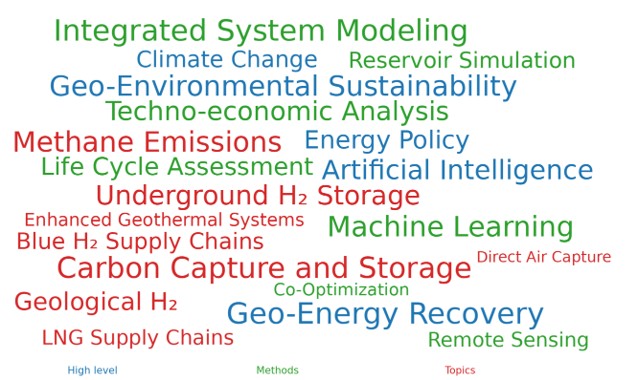
Dr. Ma’s research incorporates artificial intelligence (AI) capabilities and multiscale remote sensing emission measurement techniques (e.g., from satellites to aircraft to ground-based sensors) for geo-energy system analysis, coupling numerical methods with techno-economic analysis (TEA) and life cycle assessment (LCA) to enable the industrial-scale deployment of sustainable geo-energy extraction.
Specifically, he established two research themes as outlined below with broader applications in following areas:
- Geological carbon utilization and storage
- Methane emission quantification throughout geo-energy supply chains
- Underground hydrogen recovery and storage
- Enhanced geothermal systems
Theme 1: Holistic Geo-Energy System Modeling and Analysis
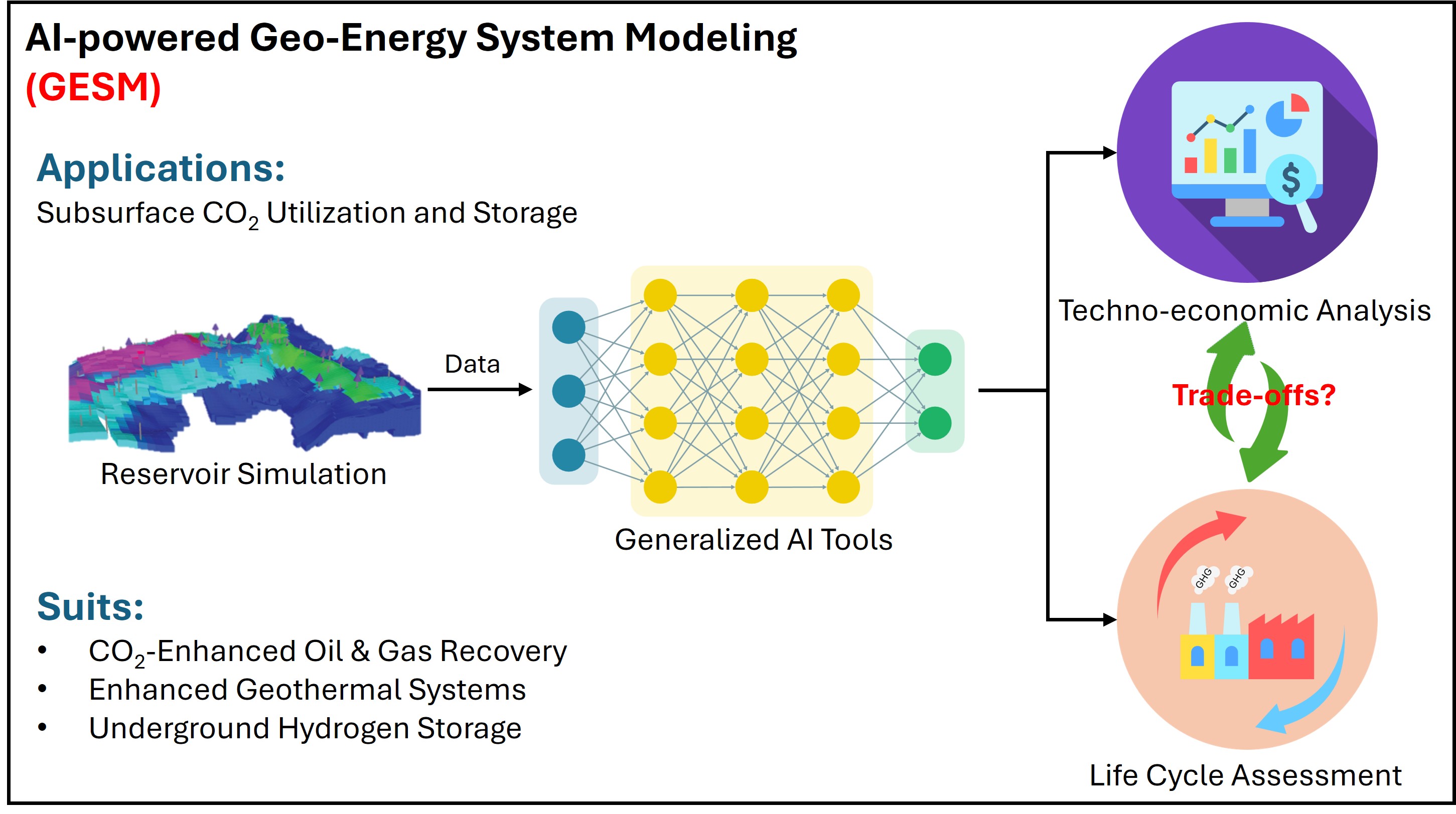
Dr. Ma lead efforts to develop a first-of-its-kind Geo-Energy System Modeling (GESM) toolkit that addresses two key knowledge gaps within the geo-energy system analysis domain: the disconnections between simulating surface and subsurface engineering activities and the lack of integration between TEA and LCA. By constructing data-enriched reduced-order models (ROMs) using machine learning algorithms that accurately predict reservoir technical performance, his work compiled these ROMs with process-level TEA and LCA estimates to evaluate the socio-economic trade-offs of the emerging geo-energy technological innovations. The GESM toolkit has already been deployed to assess industrial-scale geological carbon utilization and storage activities, such as CO2-enhanced oil recovery (CO2-EOR), CO2-enhanced shale-gas recovery (CO2-ESGR), and CO2-enhanced coal-bed-methane recovery (CO2-ECBM), as well as enhanced geothermal systems and underground hydrogen storage.
Theme 2: Geospatial Measurement-Informed Carbon Accounting and Management
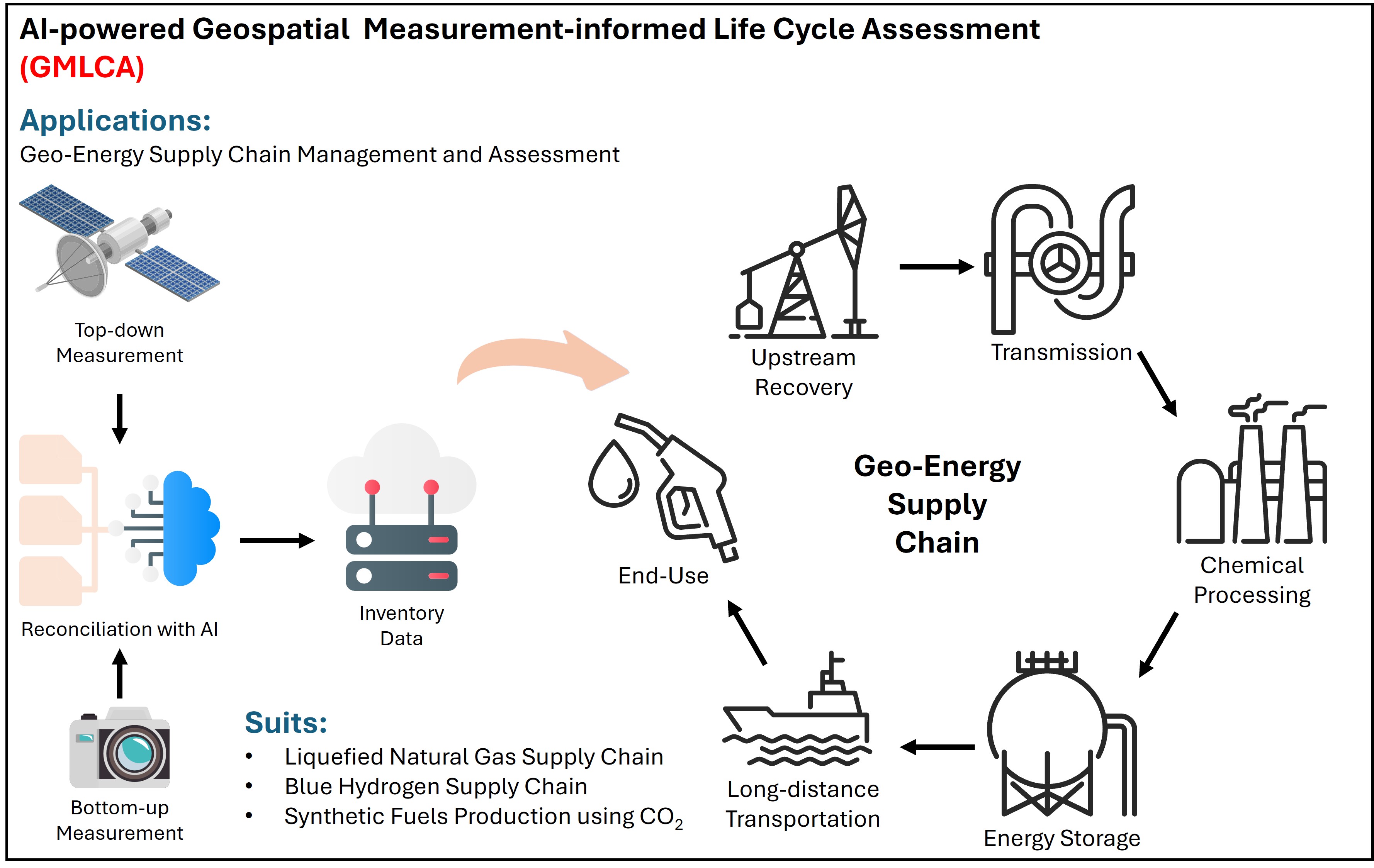
Dr. Ma developed a Geospatial Measurement-Informed Life Cycle Assessment (GMLCA) framework that leverages multiscale methane emission data, acquired from satellites to aircraft to ground-based sensors, to process-level GHG emission accounting approach. Addressing the knowledge gap between measurement-based methane inventories and national greenhouse gas emission inventories (GHGEI), this framework reconciles discrepancies by explicitly accounting for the intermittent emissions from super-emitters captured in top-down surveys of geo-energy supply chains. For example, by applying GMLCA to the global liquefied natural gas (LNG) production, his work concluded that the existing GHG emissions of the international LNG trade were underestimated by up to 33% in 2023. This framework is now being extended to the blue hydrogen supply chains produced via steam methane reforming (SMR), as well as synthetic aviation fuels (SAF) produced from various captured CO2 sources.